

The Complete Guide to Sourcing Squishy Toys from China (2026)
Sourcing squishy toys from China can feel overwhelming when you are thousands of kilometers away from the factory floor. Between MOQs, certificates, shipping terms and a market that moves at trend speed, it is easy to make expensive mistakes. This guide condenses everything we have learned running a sourcing desk inside Yiwu International Trade City into one complete playbook — whether you buy through us or not.
Before committing to a supplier, model your true per-unit cost with our landed cost calculation guide, and compare sourcing geographies in our China vs Vietnam toy manufacturing comparison.
Written by the King Squishy Sourcing Team — we walk the Yiwu market stalls every week, audit partner factories in person, and handle every step from sampling to DDP delivery for buyers in 80+ countries.
Quick answer: Sourcing squishy toys from China works best through a shortlist of vetted factories plus one party that owns QC. Expect MOQs of one carton per design (one style per carton), CPC/EN71 paperwork as standard, 15-25 day bulk lead times, and DDP door-to-door shipping on request. The biggest cost mistakes are skipping pre-shipment inspection and underestimating freight — not the unit price itself.
Why China Dominates Squishy Toy Production
Two industrial clusters produce the overwhelming majority of the world’s squishy and slow-rise toys: Yiwu in Zhejiang Province and Shantou (Chenghai) in Guangdong. Yiwu excels at market-driven, trend-responsive production — its huge trade city lets buyers mix tiny quantities across hundreds of specialist workshops. Shantou runs larger, more automated plastic factories suited to big single-SKU volumes.
For squishies specifically — slow-rise PU foam buns, cubes, fruits and animals — Yiwu’s ecosystem is unmatched. A single market district can source the foam, the paint, the packaging and the freight forwarding within a few blocks, which is why new designs go from sketch to sample in under a week.
Types of Squishy Toys Available
Steamed Buns & Slow-Rise Classics
The signature squishy: soft PU foam that springs back over 3–5 seconds. Best for checkout counters, gift shops and social-media-friendly retail. See our steamed bun collection u2192
Squeeze Cubes & Blocks
Denser foam with reinforced corners — the desk-toy channel’s favorite. Quiet, durable and easy to private-label. Explore squeeze cubes u2192
Stress Balls
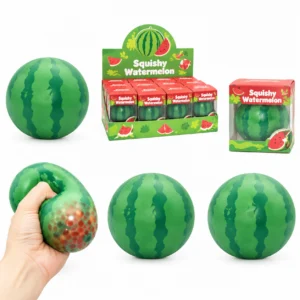
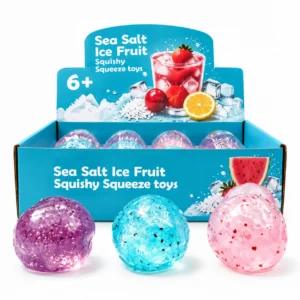
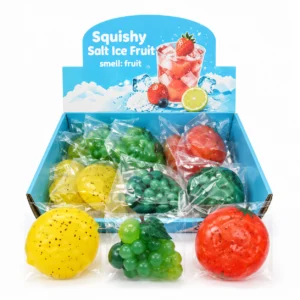
Latex-free TPR shells with gel or bead fills. The promo-product channel loves these for logo printing. Browse stress balls u2192
Novelty & Fidget
Pop bands, gyro rings, light-up variants — trend-driven lines where mechanism quality decides your review scores. View novelty fidget u2192
How to Find the Right Supplier
You have three realistic routes: marketplaces like Alibaba and 1688, a traditional trading company, or a sourcing desk embedded in the market. Each has trade-offs — our honest comparison lives at Why King Squishy.
Whichever route you choose, run this five-step filter:
- Verify the business license and export history. Ask for the license number and cross-check it.
- Request real factory photos or video. Production-line footage, not showroom clips.
- Order samples before any deposit. Samples must come from the actual production line, not a showroom shelf.
- Confirm certificates match the product category. CPC for the US, EN71 for the EU — tied to batch numbers, not just PDFs.
- Agree on inspection terms in writing. Who checks, when, and what happens when something fails.
Our detailed walkthrough of factory vetting is here: How to vet a fidget toy manufacturer u2192
Understanding MOQ and Pricing
MOQ decides how much cash you risk on an unproven design. Market-standard MOQs run 200–500 pieces per design; ours is deliberately lower at one carton per SKU with one style per carton, because testing small is how smart buyers avoid dead stock.
Real pricing matters more than promises. We publish our live catalog ranges openly: 2026 Wholesale Price List u2192. Current ranges across six collections span $0.59–5.22 FOB Yiwu, with volume tiers around 500 / 2,000 / 5,000 pieces per SKU.
Quality Control and Certifications
For children’s products, paperwork is not optional:
- CPC (Children’s Product Certificate) — mandatory for the US market, referenced to ASTM F963 testing.
- EN71 Part 1–3 — the EU standard covering mechanical safety, flammability and chemicals.
- Tracking labels — batch-level marking linking each toy to its production date.
The full breakdown of documents we provide with every order lives here: Certifications & Test Reports u2192
Shipping and Logistics
Shipping terms decide your true landed cost. The three you will meet:
| Term | Who pays freight | Who clears customs | Best for |
|---|---|---|---|
| EXW | Buyer, from factory door | Buyer | Experienced importers with agents in China |
| FOB | Buyer, from origin port | Buyer | Importers with trusted forwarders |
| DDP | Seller, to your door | Seller | First-time buyers and lean teams |
We default to DDP because it removes the two biggest pain points for new importers: customs paperwork and surprise duty bills. Typical door-to-door times on sea freight: US 22–30 days, EU 25–35 days.
Common Mistakes to Avoid
- Buying the sample, skipping the golden-sample process. Your approval reference protects you in every later dispute.
- Chasing the absolute lowest price. The cheapest quote usually skips steps — paint quality, seam strength, certificate renewals — that cost more later.
- Ignoring labeling requirements. Missing tracking labels or age warnings can block an entire shipment at customs.
- Paying 100% upfront. Standard terms are 30% deposit, balance against the B/L copy — anything else shifts all risk onto you.
- Scaling a trend before testing it. One carton tells you more than any spreadsheet.
Frequently Asked Questions
What is the realistic total cost beyond the unit price?
With DDP shipping, nothing at arrival — duties, taxes and freight are prepaid. Budget only for local last-mile if you use your own warehouse.
How fast can I get samples?
3–7 days by courier worldwide, with the fee credited against your first bulk order.
Can I mix different designs in one order?
Each carton ships as a single style. Volume tier pricing still applies per design.
Do you support custom logos and packaging?
OEM logo printing starts at 500 pcs per SKU; fully custom retail boxes at 1,000 pcs.
What certificates come with the toys?
CPC and EN71 Part 1–3 reports tied to batch numbers, plus tracking labels for the US market.
How long does the whole process take?
Sampling 3–7 days, production 15–25 days, then DDP transit: US 22–30 days, EU 25–35 by sea. Air freight cuts transit to 5–9 days.
What payment terms are standard?
30% deposit to start production, balance against the B/L copy.
Can I start smaller than one carton?
Samples yes — but one carton is the smallest bulk run, precisely so first-time buyers can test real market response without heavy risk.
Next Steps
The fastest way to test this guide is to run one small loop end to end: pick three designs, request a quote, approve samples, and hold the finished carton in your hands. Everything after that is repetition at scale.
- Browse the full catalog u2192
- Request a quote — replies within 24 hours u2192
- WhatsApp the desk directly: +86 182 6776 0712
On the floor of Yiwu International Trade City since day one. Every guide is written from live wholesale experience — no AI fluff, no secondhand theory.
A Practical Visit to Yiwu International Trade City
If you can make the trip, walking District 1 (District 1) changes how you buy forever. The market is organized by product category floor by floor — District 1 alone holds thousands of toy and gift stalls, many of which run their own workshops in nearby industrial parks.
How to Work the Market Efficiently
- Go with a shortlist. Screenshot 10–20 designs you like from online catalogs first; aimless browsing burns a full day fast.
- Photograph every stall card. Each stall has a QR business card — photograph them so you can reconnect after you fly home.
- Negotiate on quantity, not unit price alone. Stall owners flex on MOQ and carton-packing ratios far more than on headline pricing.
- Collect physical samples as you walk. Most stalls hand out free samples; carry a tote — by afternoon you will have a full comparison set.
- Hire a translator only if needed. Younger stall owners increasingly handle English over WeChat translate; a part-day translator costs 300–500 RMB if conversations get technical.
Can’t fly in? A sourcing desk does this walk for you weekly — that is literally our job description. More about how we work u2192
Reading a Quotation Line by Line
The quote is where hidden costs hide. Here is what every line should say — and what to question when it doesn’t:
| Line item | What it should include | Red flag if missing |
|---|---|---|
| Unit price (FOB or DDP) | Specified Incoterm + port/city | “FOB China” with no port named |
| Mold/tooling fee | One-time cost, amortization terms | Silent tooling fees added later |
| Packaging spec | Opp bag / blister / gift box + artwork cost | “Standard packaging” undefined |
| Sample fee & credit policy | Fee amount and credit conditions | Non-refundable samples with no credit |
| Lead time | Days from deposit confirmation, not from PO date | Vague “about 3 weeks” |
| Payment terms | % split and trigger points | 100% upfront demands |
Ask every supplier to quote on the same template so you compare apples to apples. A desk that refuses line-item detail is telling you something.
Packaging: Your Silent Salesperson
In wholesale toys, packaging decisions swing perceived value more than the toy itself. The main options, cheapest to richest:
- Opp bag (poly bag): the default. Adds nothing to cost but also nothing to shelf appeal. Always confirm age-warning print compliance for your market.
- Blister card: hangs on retail pegs, adds roughly $0.10–0.20 per unit. Best for checkout and pegboard channels.
- Printed gift box: adds $0.15–0.50 depending on size and print complexity. Lifts gift-channel perceived value dramatically.
- Display box: counter display units (CDUs) for 12–24 pieces turn a carton into an instant retail corner.
A useful rule from our buyer data: packaging upgrades pay for themselves when retail price exceeds 4u00d7 the ex-factory cost. Below that ratio, poly bags keep your margins honest.
The Seasonal Buying Calendar
Toys are a deadline business. Missing a season means waiting a full year — so reverse-plan from the retail date:
| Retail season | Order by | Notes |
|---|---|---|
| Halloween (Oct) | May–June production, ship by August | Halloween squishy lines sell out by September |
| Christmas (Dec) | July–August production, ship by October | Peak congestion — book freight early |
| Easter (Mar–Apr) | October–November production | Pastel colors and bunny variants lead |
| Back-to-School (Aug) | March–April production | Desk toys and fidget lines peak |
Reorders of proven designs run faster — 10–18 days on our lines — because tooling and QC baselines stay warm. First-time buyers should plan conservatively; repeat buyers can plan aggressively.
Building Long-Term Supplier Relationships
The biggest margin improvements come not from negotiating harder but from becoming the client factories prioritize:
- Pay on time, every time. Factories schedule their best clients’ runs first when capacity tightens before peak season.
- Consolidate volume. Spreading orders across six suppliers makes you small everywhere; concentrating makes you important somewhere.
- Share sell-through data. Factories plan better when you tell them what sold — and they reward you with first look at new designs.
- Visit when you can. Even one trip transforms how a factory treats your file. Video calls help; presence compounds.
This is the core argument for a sourcing desk: the desk’s aggregate volume buys priority you could never earn alone at one-carton scale.
Payment Security Without a Trust History
First-time buyers worry most about paying deposits to strangers. Standard protections, in order of strength:
- Trade Assurance-style platforms hold funds until shipment confirmation, at the cost of platform pricing.
- 30/70 telegraphic transfer against B/L copy is the industry standard — the deposit covers materials, the balance transfers control to you.
- Photo documentation at every stage makes any dispute resolvable within days rather than months.
- Start small. A one-carton trial order costs less than most plane tickets and tells you everything.
Never wire 100% before production on a first order with an unverified supplier — no matter how good the discount sounds.
Frequently Asked Questions (continued)
Do I need an import license to buy toys from China?
Most consumer importers operate under general trading licenses; specific requirements vary by country and product category. Your customs broker confirms before ordering.
How do I handle product liability insurance?
CPC/EN71 certificates from the factory support your liability coverage. Product liability insurance is strongly recommended once you scale past test volumes — annual policies for toy importers are widely available.
What happens if my country changes toy safety rules?
Rule changes are announced months ahead. A sourcing desk tracks them across markets and flags affected SKUs before they become border problems.
The Negotiation Playbook
Negotiating with Chinese factories is not about aggressive haggling — it is about finding the configuration where both sides win. The tactics that actually move numbers:
- Negotiate the package, not the unit. A supplier will hold firm on unit price but flex on MOQ, sample fees, packaging upgrades or payment split. Ask for two or three of those together and the effective discount compounds.
- Use silence after the first counter. The first price is rarely the floor; a pause invites a second offer without you conceding anything.
- Bundle future volume into the present quote. “If this first order goes well, we reorder quarterly” is the single most powerful sentence in wholesale negotiation — suppliers price today against tomorrow’s relationship.
- Never negotiate quality to hit a number. If the quote is above your target, ask what specification change gets you there — thinner paint, simpler packaging, smaller size. Price follows spec; never the reverse.
One cultural note: “no” often sounds like “we will study it.” Push gently for a concrete alternative rather than accepting vague deferral — the best partners respond with options, not silence.
Quality Inspection: What Actually Gets Checked
“Inspection” means different things to different people. A professional pre-shipment check on squishy toys covers:
- Count verification against the packing list, carton by carton.
- AQL sampling (Acceptable Quality Limit) — industry-standard statistical sampling rather than checking every piece.
- Squeeze-cycle testing on a random subset: does the foam still rise in time after hundreds of compressions?
- Paint and print adhesion — tape tests on decorated surfaces.
- Seam and glue-line review under bright light for plush and multi-part items.
- Label compliance — tracking labels, age grades, warning text present and legible.
Demand photo records of every checkpoint. Photos turn “trust me” into “see for yourself” — and they settle disputes before they start. Our desk archives batch photos for every run; ask any supplier you work with to do the same.
Freight Cost Breakdown: Where the Money Goes
The gap between FOB and DDP confuses first-time buyers. Here is roughly where each dollar of freight goes on a typical sea shipment to the US:
| Component | Share of landed freight cost |
|---|---|
| Ocean freight (port to port) | ~40% |
| Origin charges (trucking, export clearance, documentation) | ~15% |
| Destination port charges (unloading, handling) | ~20% |
| Customs duties & tariffs | Varies by HTS code — toys typically 0-8%, but verify per SKU |
| Destination trucking to door | ~15% |
| Customs brokerage | ~10% |
On DDP orders you see none of these line items — just one landed unit price. That simplicity is why we built our model around it: buyers compare shelf margins, not freight invoices.
Communication Rhythm That Prevents Disasters
Most sourcing disasters trace back to silence somewhere between deposit and delivery. The fix is a fixed communication rhythm agreed before production starts:
- Week 1: material confirmation photos — the exact foam, paint and packaging your order uses.
- Mid-point: semi-finished goods on the line, so corrections are still cheap.
- Packing: full carton contents photographed open, then sealed.
- Pre-departure: final carton stack, container loading sequence, document set.
Suppliers who resist this rhythm are telling you how the relationship works long-term. Ours is standard operating procedure — written into every quote.
When Things Go Wrong: A Real Recovery Example
A US buyer received a carton where one SKU arrived with paint defects affecting about 15% of units. Because batch photos existed from packing stage, the defect was traced to a single paint batch — not the whole run. Resolution within three business days: affected pieces replaced on the next production slot at no cost, plus a discount on the following order. Total disruption: one email thread with six photos attached. Documentation turns disasters into inconveniences.
What Is Inside a Factory Quotation
Understanding cost structure makes you a sharper negotiator. A typical slow-rise squishy’s ex-factory price breaks down approximately as:
| Component | Share of ex-factory price |
|---|---|
| PU foam raw material | ~35% |
| Labor (molding, painting, assembly, QC) | ~25% |
| Packaging materials | ~12% |
| Factory overhead & margin | ~20% |
| Certification amortization | ~8% |
Two insights follow. First, raw material prices move with oil — when crude spikes, foam quotes rise within a quarter, so lock longer runs before known material inflation. Second, labor intensity explains why hand-painted designs cost structurally more than single-mold items: it is not margin, it is minutes.
Container Economics: When Full Loads Make Sense
A 40-foot high-cube container holds roughly 60,000–80,000 squishy units depending on size and packaging. At that scale, per-unit ocean freight drops from $0.30–0.50 down to $0.08–0.15 — which is why experienced importers graduate from mixed LCL cartons to full containers as volumes grow. The crossover point for most buyers sits around 8,000–12,000 mixed pieces: below that, shared LCL keeps cash free; above it, FCL slashes landed cost per unit enough to matter.
Buying Notes by Category
Squishy Buns: Check the Rise Time
The defining quality metric is rebound speed — premium slow-rise foam returns to shape over 3–5 seconds. Faster rebound usually means cheaper foam blend. Squeeze a sample ten times in succession; quality foam recovers consistently without going flat.
Cubes: Corners Tell the Story
Cube durability lives in the corners. Cheap versions split at stress points within weeks. Ask for corner drop-test photos or order one sample specifically to abuse.
Fruits & Food Shapes: Consistency Is the Challenge
Hand-painted details vary piece to piece — that is normal and part of the charm. What matters is color consistency across the batch. Compare three random units under the same light before approving production.
The Compliance Timeline Nobody Tells You About
Testing and certification are not instant — build them into your calendar:
- New mold + first CPC: 2–3 weeks for lab testing after samples exist.
- EN71 refresh: annual or upon material change — confirm certificates are current, not expired reprints.
- Tracking label design: approve alongside packaging artwork so print runs combine.
A sourcing desk manages this calendar for you; going direct means managing it yourself, per factory.
Final Word: Start Small, Learn Fast, Scale What Works
Every lesson in this guide compresses into one principle: risk small, verify everything, then scale with confidence. The buyers who succeed in Yiwu sourcing are not the ones with the biggest first orders — they are the ones who ran clean one-carton test loops, built documented relationships, and scaled only what the market confirmed.
The desk behind this guide exists to run that loop with you. Bring a product idea; leave with a plan.
Related Guides
 Top Wholesale Squishy Toy Suppliers 2026: Channels & MOQs
 Wholesale Toy Packaging: Custom Boxes, Labels & Inserts
 How to Create Your Own Fidget Toy Brand (2026 Guide)
Shop Stress Balls Wholesale
Add these best-sellers to your next order.