

TPR vs PU Foam vs Silicone: Choosing Fidget Toy Material
Material choice is the highest-leverage decision in a fidget product line — and it maps directly onto squishy toy types — it sets unit cost, durability, compliance pathway and even which channels will carry you. Yet most buyer conversations start with designs, not materials, and only discover the trade-offs after samples arrive wrong. This comparison puts the three dominant materials side by side — TPR vs. PU foam vs. silicone — using real catalog price bands and channel fit, ending with a clear verdict matrix by business type.
To see how each material behaves in finished products, the Squishy Toys Explained guide maps materials to product categories.
Once you’ve picked a material, our complete guide to sourcing squishy toys from China covers how to vet suppliers for each format.
Quick answer: PU foam wins on cost-per-unit and trend variety ($0.59–$3.73 typical FOB), making it the default for collectible squishies and prize-channel volume. TPR wins on durability and washability — the standard for stress balls ($0.83–$1.35) and logo-printed promo programs. Silicone wins on premium feel and longevity at the highest unit cost — best for adult-focused, high-margin lines rather than volume plays.
Side-by-Side Comparison
| Criterion | PU foam (slow-rise) | TPR (stretch elastomer) | Silicone |
|---|---|---|---|
| Hand feel | Ultra-soft, 3–5s slow rise | Stretchy, squishy rebound | Smooth, dense, premium |
| Durability | Moderate — seams/paint wear with heavy use | High — survives drops, washing | Highest — heat/tear resistant |
| Typical FOB band* | $0.59–$5.22 across collections | $0.83–$1.35 stress-ball range | Premium tier above foam basics |
| Design velocity | Highest — new molds monthly | Moderate | Lower, tooling-cost driven |
| Logo printing | Limited (surface paint) | Excellent — pad print staple of promo channel | Good — deboss/laser common |
| Cleaning | Spot clean only | Washable | Dishwasher-easy, non-porous |
| Best-fit channels | Retail collectibles, prize/claw, subscription boxes | Promo products, schools, vending | Adult/wellness premium retail |
| *Live King Squishy catalog bands, FOB Yiwu 2026 | Full ranges in our price list | ||
PU Foam: The Volume Engine
Slow-rise polyurethane is what most people picture when they hear “squishy”: buns, strawberries, mochi, animals that compress and spring back over seconds. Its structural advantages are economics and variety — foam tooling is inexpensive enough that factories launch new shapes continuously (our food-shapes line alone spans 100 SKUs), keeping assortment fresh at MOQ-friendly quantities. The trade-offs are physical: painted surfaces wear with aggressive use, foam is spot-clean only, and small attached parts demand honest age grading (3+ typically) under small-parts rules.
Choose PU when: you need breadth of designs at the lowest landed cost, feed a trend-sensitive channel (retail impulse, claw machines, subscription boxes), or rotate assortment faster than durability matters.
TPR: The Durability Workhorse
Thermoplastic rubber — latex-free by formulation — dominates wherever products take abuse: stress balls with gel or bead fills, squeeze cubes that survive desks and backpacks, therapy tools that get washed nightly. It accepts crisp pad printing, which is why promotional-product distributors default to TPR for logo programs. Our stress-ball collection’s tight $0.83–$1.35 band shows its other virtue: predictable costing for quote-driven channels.
Choose TPR when: longevity justifies slightly higher unit cost — institutional buyers, corporate gifting, vending routes, and anything that must survive repeated cleaning. Our materials deep-dive covers fill options and testing notes.
Silicone: The Premium Statement
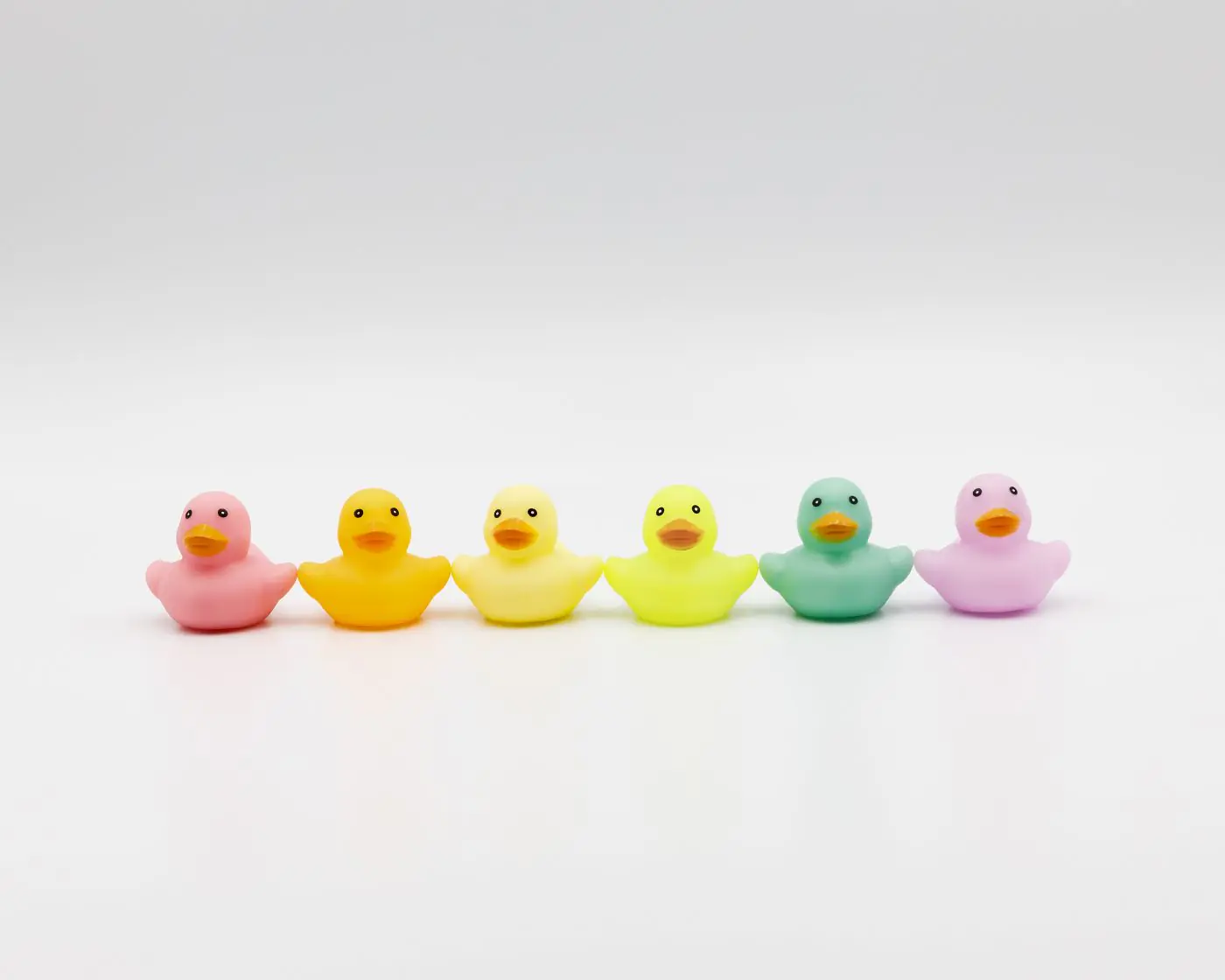
Platinum-cured silicone costs more per unit and changes less often — and deliberately so. Non-porous, dishwasher-safe, temperature-tolerant and pleasantly dense, it reads “quality” in the hand, which is exactly the signal adult-focused wellness and desk-accessory lines need. Margins work through positioning rather than volume: fewer SKUs, higher price points, longer reorder cycles.
Choose silicone when: your brand promise is premium and longevity-backed — executive gifts, wellness retail, clinical-adjacent sensory tools — rather than trend chasing.
Standalone takeaway: Match material to channel, not to personal preference: PU for trend volume, TPR for durability-driven institutions and promo, silicone for premium positioning. Mixing two materials across a product family is normal — forcing one material into the wrong channel is the actual mistake.
Compliance Applies to All Three
Whatever the material, children’s products entering the US require CPC documentation referencing ASTM F963 third-party testing, and the EU requires EN71 Parts 1–3; material choice changes test specifics (phthalate panels matter for soft plastics) but never removes the paperwork obligation. We ship batch-linked reports with every order — see exactly what’s included on our certifications page.
Frequently Asked Questions
Which material is cheapest for wholesale fidget toys?
PU foam delivers the lowest cost per unit with the widest design range — our catalog spans $0.59–$5.22 FOB across foam collections, with many core designs averaging near $1. TPR sits close behind in simple forms like stress balls; silicone carries the highest unit cost.
Are TPR toys safe for children?
Quality TPR is latex-free and widely used in children’s products, but safety comes from documented compliance, not material alone: require CPC (US) and EN71 (EU) reports tied to production batches from any supplier.
Can I order multiple materials?
Yes — each carton ships as a single style, so order PU collectibles for retail and TPR stress balls for promo quotes as separate cartons under one shipment and one document set.
What material should a subscription box use?
PU foam leads for variety-driven boxes because monthly novelty depends on fast-moving mold pipelines; add occasional TPR or silicone hero pieces for perceived-value spikes without breaking content budgets.
On the floor of Yiwu International Trade City since day one. Every guide is written from live wholesale experience — no AI fluff, no secondhand theory.
Related Guides
 Five Below Squishy Toys: What Sells & How to Source
 Squishy Advent Calendar Wholesale: The 24-Day Dumpling Calendar
 Fidget Toys for Caregivers: You Need Stress Tools Too
Shop Stress Balls Wholesale
Add these best-sellers to your next order.